
Foot Flare Adjustments – Pros and Cons
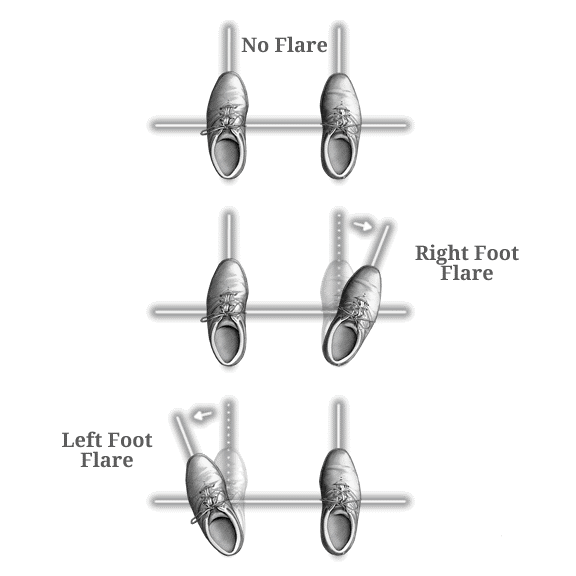
In golf, flaring one’s foot corresponds to angling it out slightly so that the line of the foot is not perpendicular to the target line. This is in contrast to seeing both feet parallel to each other and perpendicular to the target line. You can decide to position your feet likewise or flare either of your feet.
The pros and cons of such tweaks are explained below.
No Flare – Neutral Foot Position
The standard – or default – position in golf involves no foot flaring at all.
Indeed, in this situation both feet are aligned so that they are parallel to each other while at the same time perpendicular to the target line.
Combined with a decent amount of knee flex, this position provides very good load support and could definitely be considered an athletic position.
Benefits
There are two main advantages to not flaring your feet at all.
Firstly, it promotes consistency
through the fact that the feet are always positioned the same way. And that same way is very easy to replicate over and over again since a right angle is easier to reproduce than an exact 10 degree angle, for example.
Secondly, it is much easier to align your stance with the target
line when the toes are the same distance from the target line. Indeed, flaring your foot tweaks the toe line slightly which can make it more difficult to line up properly for a shot.
While that may not be problematic for a square stance, it will become trickier for an open or closed stance that might be required for a certain shot shape.
This is why it is generally recommended to align your stance using your heels rather than your toes when setting up for a shot using flared feet.
Drawbacks
The main negative to not flaring your feet at all is that is may constrain your swing amplitude.
This is especially true for golfers with flexibility issues. Indeed, senior golfers or those with certain lower body injuries may be unable to perform a golf swing properly unless their stance allows for foot flaring.
Left Foot Flare
Flaring your left foot involves rotating your left leg out so that your toes are angled slightly to the left. Or in other words, instead of pointing straight forward, your left foot is positioned so that it points to the left slightly.
This foot positioning method was promoted by Ben Hogan in his bestselling “Five Lessons” book.
Effects
While it does not necessarily do this on its own, flaring your left foot tends to rotate your hips slightly towards the target.
This in turn will lead to an outside-to-in swing path that will promote a fade, or at least one with left-to-right sidespin.
Benefits
By opening the left foot slightly you are in effect making more room for the body rotation to occur past the moment of impact. This in turn will lead to a fuller – and easier to perform – follow through.
Drawbacks
On the flip side, since more room for the follow through has been created, it has happened at the expense of room available for the body’s rotation back.
Consequently, the backswing is somewhat reduced in the amplitude it is allowed to comfortably operate in. It is therefore not recommended to flare your left foot if you are looking to increase the width of your backswing or if you suffer from stiffness that limit your backswing already.
Right Foot Flare
Flaring your right foot involves angling it out.
Or in other words it involves rotating your right foot to the right a little so that your foot is no longer pointing directly forward but rather to the right slightly.
Effects
Similarly to the left foot flare, adopting a right foot flare tends to change the angle of the hips slightly.
In this case, it tends to close the hip line in relation to the target line. This has for consequence that it favors an inside-to-out swing path and ultimately to a draw, or at least to a ball with right-to-left sidespin.
Benefits
Flaring the right foot slightly creates more room for the backswing to operate in, and leads to a more comfortable position at the top of the swing.
This leads to a fuller backswing amplitude that can help generate more clubhead velocity and ultimately to more distance.
This can be particularly helpful to those with flexibility issues that restrict how far back they can turn their hips and shoulders and ultimately their club.
Drawbacks
On the flip side, creating more room for the backswing is achieved at the cost of room available for the follow through. So while you are gaining in how far you can comfortably bring the club back and up you are forfeiting some of the benefits to a wide and full follow through.
Conclusion
As we’ve seen flaring your left or right foot – or not flaring them at all – has its own set of advantages and disadvantages.
While golfing greats such as Ben Hogan made it clear he thought the left foot should be flared, it can be useful to experiment with each permutation in order to determine what works best for your own scenario, taking into account what you are trying to achieve and whether you have physical restrictions that warrant one scenario over the other.
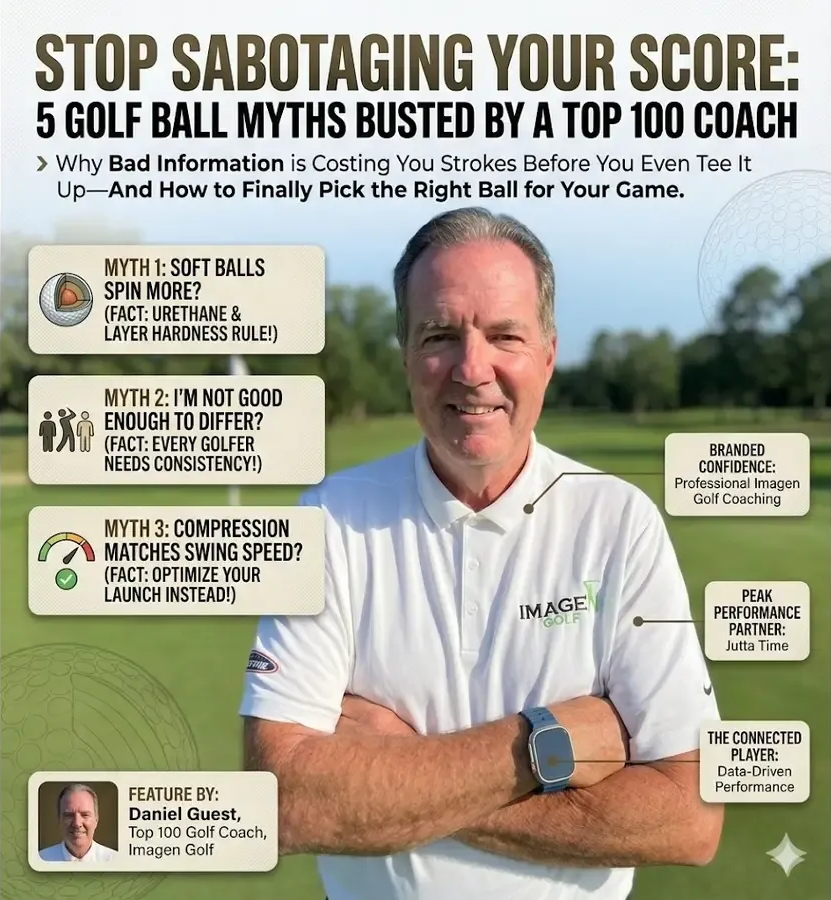
Stop letting bad equipment advice ruin your rounds. Discover the truth about spin, compression, and the fastest way to dial in your distance Hey everyone, Daniel Guest here from Imagen Golf. If you've spent any time on the lesson tee with me, you know I’m passionate about controlling the variables you can control. Golf is hard enough. But out in the equipment world, there is an absolute avalanche of bad information—especially when it comes to the one piece of equipment you use on literally every single shot: the golf ball. When you play based on bad info, you make bad decisions. And bad decisions cost you strokes before you even tee it up. Today, we are putting the five biggest golf ball myths to bed so you can start playing with confidence, consistency, and a strategy that actually lowers your scores. Let’s get into it.
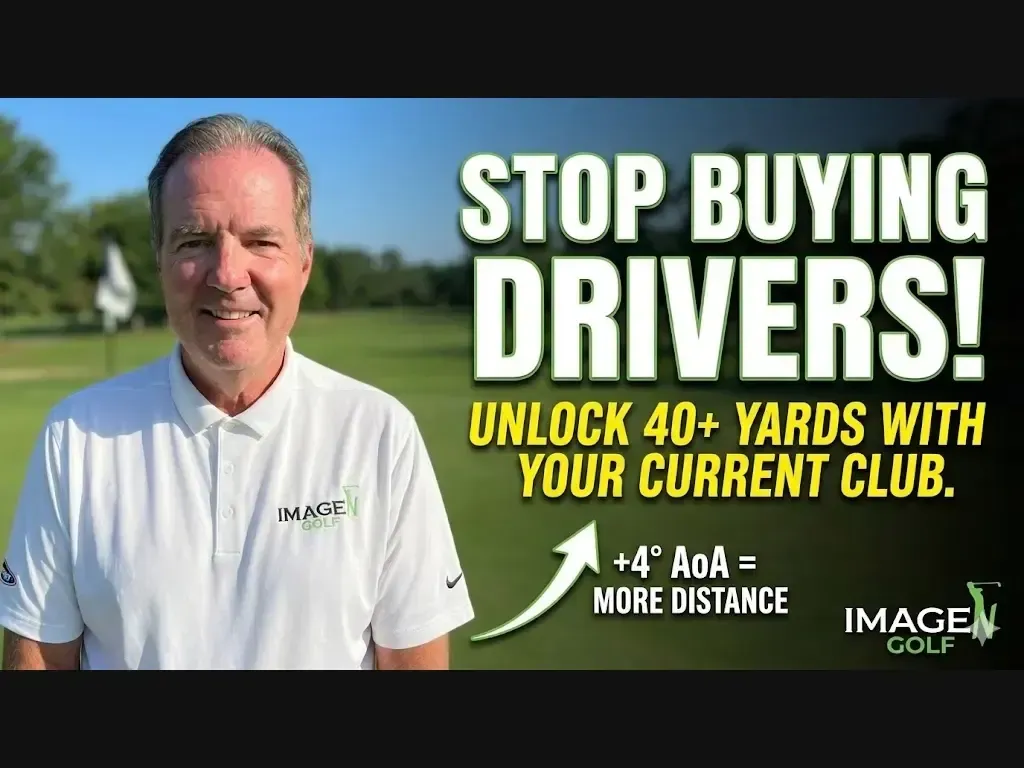
How to Get 40 Extra Yards of Carry Distance Without Swinging a Single MPH Faster.

Daniel Guest grew up surrounded by golf. His great, great grandfather played professionally in Scotland, and his great-uncle, Thomas Fischer, became the first golf professional at the DuPont Country Club in Wilmington, Delaware.
As the founder of Imagen Golf, Daniel Guest has redefined how players learn, practice, and experience the game.

Top 100 Coach Daniel Guest combines Trackman iO, app-based lesson storage, and remote weekly check-ins to provide 24/7 coaching support.
If you tried to book a Saturday morning tee time recently and found yourself staring at a screen that looked more like a sold-out Taylor Swift concert than a municipal golf course, you aren’t alone. According to a year-end message from the National Golf Foundation (NGF), more people are playing golf in more ways than at any time in recorded history. For the crusty veteran who misses the days of the four-hour round and empty fairways, this might sound like a nightmare. But for anyone who loves the vitality, future, and "cool factor" of our sport, we are officially living in the Golden Age of Golf. Here is what the numbers actually mean for your game, your wallet, and that lukewarm hot dog at the turn.

The calendar page is about to flip, and with it, the conversation that's been bubbling beneath the surface of the golf world is set to boil over: Tiger Woods turns 50 on December 30th. That golden birthday means a gold-plated invite to the PGA Tour Champions. As President of Imagen Golf, I've spent years analyzing swings, but with Tiger, we're not just looking at a swing—we're analyzing the DNA of a champion's competitive spirit, and that is where the real story lies.

Hello, I'm Daniel Guest from Imagen Golf, and today we're tackling a topic that chills many golfers: playing in the cold. It’s not just you; the cold weather fundamentally changes how your equipment—specifically the golf ball—performs, and that directly impacts your shot.1 Understanding these effects is the first step toward better cold-weather scoring.
Expert short game lesson guidance for Newtown residents. Learn how to choose the right golf instructor and what to expect from quality short game instruction.

Expert outdoor golf lesson guidance for Lansdale residents. Learn how to choose the right golf instructor and what to expect from quality outdoor instruction.