
You Can’t Buy a Better Swing: Why Equipment Is Masking Your Mishits
If you've spent any time around the lesson tee at Imagen Golf, you know I'm going to give it to you straight.
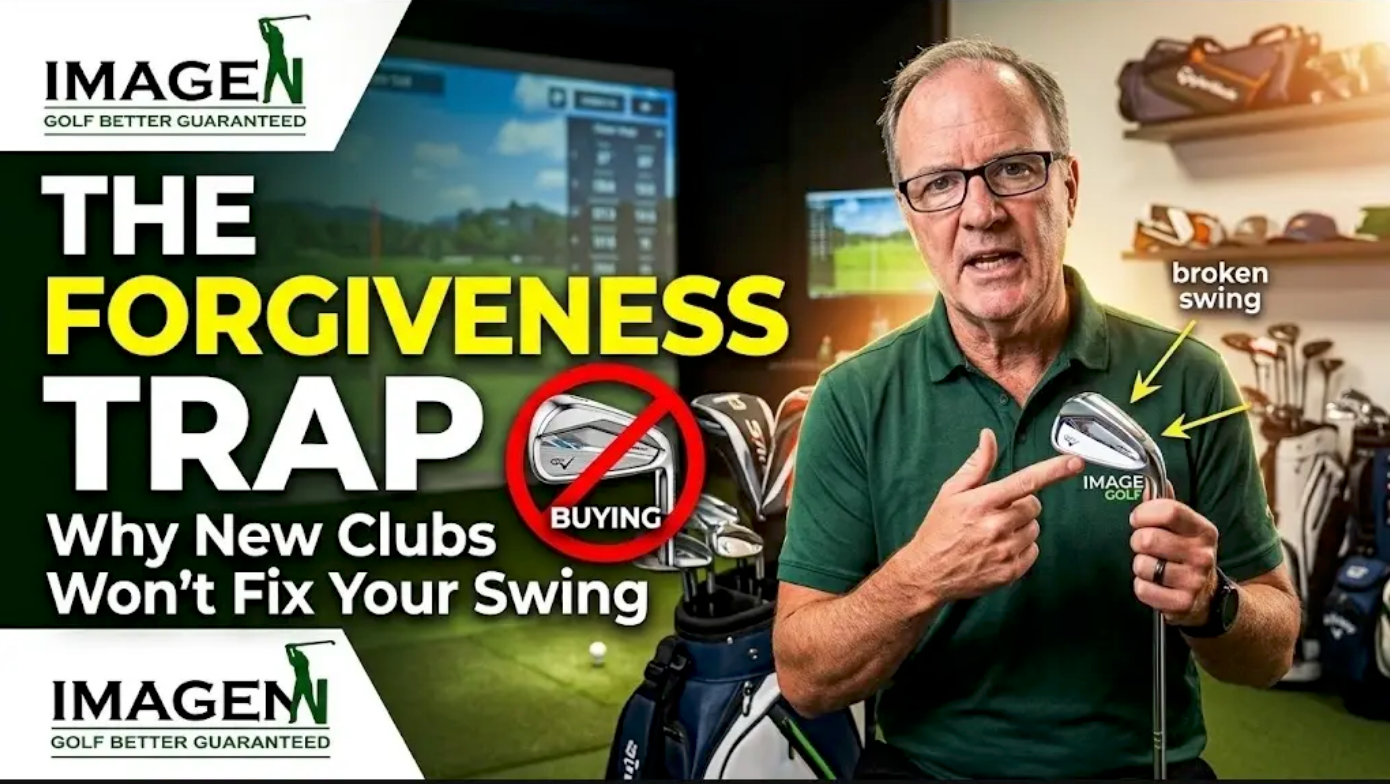
Every year, I see golfers drop thousands of dollars on the latest game-improvement irons and specialist wedges. They are looking for a magic pill. But here is the hard truth we need to face: is your equipment actually helping you develop as a golfer, or is it just making your bad habits easier to live with?
The Quick Answer: Forgiveness in golf clubs masks your mishits by reducing the penalty of off-center strikes. However, relying on forgiving equipment without improving your mechanics prevents you from lowering your scores. To truly improve, you must build a repeatable swing first, then buy equipment that complements your consistent contact.
We have access to more golf instruction and advanced equipment than any generation before us. You can record your swing on your phone in 4K and instantly buy clubs designed to rescue your fat and thin shots. Yet, the most common problem remains: producing a reliable, center-face strike when the pressure is on.
Here is what every golfer needs to understand about the gap between the swing you are trying to buy and the swing you actually own.
The Problem with the Impact Safety Net
Game-improvement irons and high-bounce wedges approach your swing flaws from different angles.
Perimeter weighting in irons minimizes the disaster of a toe or heel strike. In your wedges, specific grinds and high bounce angles prevent the leading edge from digging into the turf when you release the club too early. Equipment manufacturers like Titleist do incredible engineering to match clubs to a player’s actual, flawed delivery rather than an imaginary perfect swing.
That is brilliant engineering, but let's not get confused. A less damaging miss and a repeatable, athletic golf swing are two completely different things. A forgiving club preserves a mediocre result; it does not teach you why you are hitting it off the toe or why your club is bottoming out six inches behind the golf ball.
The Wedge Gapping Trap
Let’s look at where the iron set connects to your scoring clubs. The modern "Pitching Wedge" is often stamped with a "P", but its loft tells a different story.
When your game-improvement iron set features a strong-lofted 44-degree pitching wedge, and you carry a traditional 56-degree sand wedge, you have a massive 12-degree loft gap. That doesn't just mean a yardage gap; it means a massive scoring leak.
More wedges can give you better distance control, but only if you know how to use them. If you know the loft stamped on the bottom of the club but have no idea what your actual carry distance is with a comfortable swing, versatility just breeds uncertainty. When you stand over a short approach with three different wedges and no practiced shot in your arsenal, you aren't versatile—you're guessing.
Watching YouTube is Not Learning
We live in the golden age of golf instruction. But access to information is not the same thing as learning.
Right now, a golfer can collect mechanical swing thoughts faster than they can ever test them. One range session is about bowing the lead wrist, the next is about clearing the hips, and the next is a completely different drill you saw on Instagram.
Technical instruction is vital, but learning requires a clear priority, accurate feedback, and enough repetition to turn that priority into muscle memory. Equipment offers instant gratification—a quick swipe of the credit card and the promise of a better result. Building a swing takes time. But when every recurring slice or chunk leads to a new club purchase, you are treating the symptom without ever curing the disease.
The Data: Why Golf Scores Aren't Dropping
If game-improvement technology actually improved our games, the national scoring averages would be plummeting. They aren't.
According to National Golf Foundation (NGF) data, the average score for U.S. golfers who keep score hovers right around 94. It has barely moved in years.
| Scoring Threshold | Historical Proportion Reporting Scores Below It |
|---|---|
| Below 100 | 55% |
| Below 90 | 26% |
| Below 80 | 5% |
Data sourced from historical NGF surveys. Keep in mind, these are reported scores, and many weekend golfers take liberties with the rules.
The conclusion here is glaring. Despite massive leaps in forgiving technology and 24/7 access to swing tips, low scoring remains rare. Tech has not resolved the ordinary golfer's inability to produce dependable, repeatable impact. Forgiveness manages inconsistency. Real learning reduces it.
The Imagen Golf Blueprint: Ask Better Questions
Before you buy your next set of clubs, stop asking the guy at the big box store which iron is the most forgiving. Start asking what your current swing pattern actually requires:
- Where is the ball repeatedly making contact on your clubface?
- Where is your divot starting (the low point of your swing)?
- What are your exact, honest carry distances with your current wedges?
- Which short-game shot can you reproduce 8 times out of 10 under pressure?
- Will your next breakthrough come from a $1,500 iron set, or a clearer practice plan?
Connecting your equipment purchases to an observed, factual need in your swing is how you actually drop your handicap.
Stop Buying a Game. Start Building One.
Modern clubs absolutely deserve credit for making this incredibly difficult game more playable and enjoyable. But the moment you let equipment technology become a substitute for learning, you've capped your potential.
Here is my challenge to you: Judge your progress by the movement and the contact you can repeat, not by the terrible shot your oversized 7-iron managed to keep on the planet.
First, learn and master a swing technique that delivers consistent accuracy (at a 4HI level or better). Then, choose the clubs that perfectly suit that repeatable swing. Build a game that gives your clubs less rescuing to do.
