
The Holy Trinity of Putting: Why It’s Time to Overhaul Your Flatstick Game
Stop Trying to Fix Your Putting with the Same Old Broken Tools.
We’ve all been there. You stripe a 280-yard drive straight down the middle of the fairway. You follow it up by throwing a dart with your 7-iron, sticking it to twelve feet. You stride onto the green feeling like a tour pro, only to painfully three-putt for bogey.
It is the most maddening sequence in golf.
We all know the old adage, "drive for show, putt for dough." Yet, while amateur golfers routinely drop hundreds of dollars on a new driver every other year to chase five extra yards, they stubbornly cling to the exact same putter, grip, and stroke they’ve used since high school.
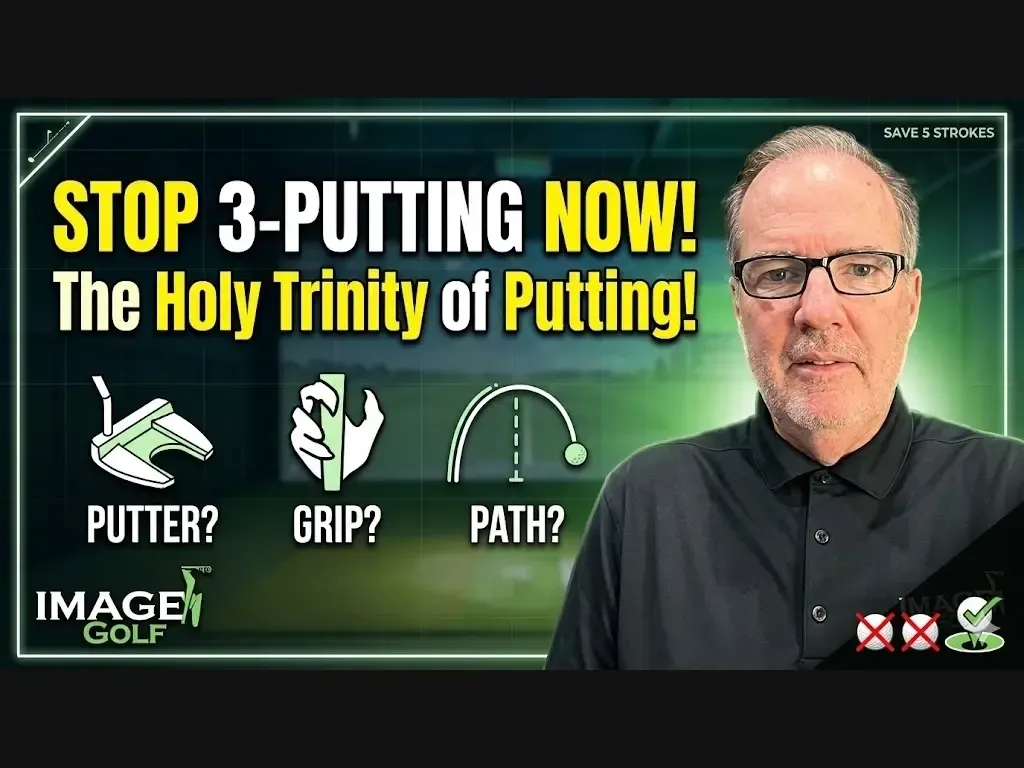
If you are struggling on the greens, it isn't just about practicing more; it's about practicing smarter with the right tools. To unlock your potential, you need to evaluate what we at the Imagen Golf Podcast call the "Holy Trinity of Putting": your equipment, your grip, and your technique.
Here is why you need to update all three, and more importantly, how to ensure they work together.
Let’s be honest: how old is your putter? If you are wielding a thin, classic blade from the late 90s, you are actively making the game harder for yourself. Putters have undergone massive technological advancements in the last decade.
The biggest upgrade you get with modern putters—especially the popular mallet designs—is Moment of Inertia (MOI). High-MOI putters are incredibly forgiving. When you inevitably strike the ball slightly off the toe or the heel, a modern putter head resists twisting. The ball stays on its intended line and maintains its speed. Older blades possess a microscopic sweet spot; miss it by a fraction, and your putt is doomed.
Furthermore, modern putters utilize sophisticated alignment technology and face milling. High-contrast lines help your brain square the face, while milled inserts get the ball rolling end-over-end immediately, eliminating the skid that throws putts off-line.
The Takeaway: You wouldn't play a persimmon wood driver today. Stop playing a putter that penalizes you for being human.
2. The Grip: Neutralize the Yips
You can buy the most advanced, expensive putter on the market, but if your connection to the club is flawed, nothing will change.
For a century, the conventional reverse-overlap grip (right hand below the left for a right-handed golfer) was the gold standard. It feels athletic and natural. However, putting isn't an athletic, twitch-muscle movement—it requires a steady, mechanical pendulum motion. The conventional grip allows the right wrist to remain highly active. Under pressure, that wrist breaks down, leading to flipped putts, pulled three-footers, and the dreaded yips.
If consistency is an issue, it’s time to update your grip to neutralize your hands:
- Left-Hand Low (Cross-handed): By placing your left hand below your right, you level your shoulders and lock your lead wrist. It takes the "flip" out of the stroke and is exceptional for keeping the face square.
- The Claw / Pencil Grip: Keeping the left hand standard, the right hand comes off the grip entirely and pinches the club between the thumb and fingers. It feels bizarre at first, but it completely removes the right hand from the equation.
- The Arm-Lock: Using a longer grip pressed against the lead forearm creates a highly stable, unified lever.
The Takeaway: Leave your ego at the clubhouse. Looking slightly unorthodox on the green is much better than four-putting in front of your friends. Give an alternative grip a dedicated two-week trial.
3. The Technique: Match Your Path to Your Body
The engine driving the golf ball is your technique. The most critical element to evaluate is your putting path. Broadly speaking, there are two distinct styles:
- Straight-Back, Straight-Through (SBST): The putter face looks at the target the entire time, traveling straight down the line, striking the ball, and continuing down the line.
- The Arc: The putter comes slightly inside on the backswing like a swinging gate, squares up at impact, and swings back inside on the follow-through.
Neither is inherently wrong (Tiger Woods is a famous arc putter), but your setup must match your stroke.
If you are an SBST putter, your eyes should be directly over the golf ball at address. If you are an arc putter, your eyes need to be slightly inside the golf ball. Regardless of your stroke, the ball should be positioned slightly forward in your stance so you strike it just after the bottom of your arc, creating top-spin.
4. The Alchemic Combination: Tying It All Together
Here is the ultimate secret: Your putter, grip, and technique do not exist in a vacuum. They are mechanically linked. You cannot mix and match them at random and expect results.
- If you have an SBST stroke: You must use a Face-Balanced putter (typically a mallet). If you balance the shaft on your finger, the face points straight to the sky. It resists opening and closing.
- If you have an Arc stroke: You need a putter with Toe Hang (often a blade). The heavier toe allows the face to naturally open and close with your stroke.
If you try to use a toe-hang blade with a straight-back, straight-through stroke, you will fight the putter's natural physics all day long.
This is where the grip comes in to complete the puzzle. Let’s say you switch to the Claw grip to quiet your hands. Because the Claw naturally restricts wrist rotation, your stroke will likely flatten out and become more Straight-Back, Straight-Through. Consequently, you will likely need to trade in your toe-hang blade for a face-balanced mallet to match your new grip!
The Final Word: Evolution is part of the game. If you are serious about shaving strokes off your scorecard, start experimenting on the practice green. Better yet, book a professional putter fitting. A fitter can measure your exact biomechanics and tell you the precise combination of putter style, length, and grip that fits your natural stroke.
Find your Holy Trinity, and watch those three-putts disappear.
Join the Imagen Golf Community
Ready to stop guessing and start playing the best golf of your life? Daniel and the Imagen Golf team are constantly sharing the tools, truths, and techniques you need to lower your scores.
Connect with us, listen to the podcast, and level up your game across all our platforms:
Website: ImagenGolf.com
YouTube: Subscribe to Imagen Golf
Instagram: Follow us @ImagenGolf
X (Twitter): Join the conversation @ImagenGolf
Facebook: Like our page Imagen Golf
